

A property business spends heavily to acquire a customer and comparatively little to prove it deserves them. The features that lift lifetime value are rarely the loud ones in a campaign. They are the quiet proofs that the business is on the customer’s side.
Marketing leaders know the acquisition number cold: what it costs to win a tenant or a buyer, and how fragile that customer is until something earns their loyalty. There is one such proof most property businesses have not yet shipped, and it is the one that signals trust most powerfully at the moment it matters most.
This is not a story about adding an insurance product. It is a story about brand trust, lifetime value, and the difference between a business customers use and one they stay loyal to.
What actually drives lifetime value for a property business?
Lifetime value is driven by trust compounding over time, not by the initial transaction. A customer acquired at high cost only becomes profitable if they stay, renew, and advocate. Every moment the business proves it acts in the customer’s interest lowers churn and raises the return on what it paid to acquire them.
Marketing leaders manage a gap between acquisition and loyalty. Acquisition is expensive and measurable. Loyalty is earned in the moments after the sale, where the customer decides whether the brand’s promise was real. A business that closes that gap improves lifetime value without spending more on acquisition, which is the most efficient growth a marketing function can produce.
The features that close it are trust signals: moments where the business demonstrably looked after the customer when it did not strictly have to. Those moments are what a customer remembers at renewal and repeats to a friend.
Why is a trust signal worth more than another acquisition campaign?
A trust signal is worth more because it compounds across the customer relationship, while an acquisition campaign pays once. Reducing churn on customers already acquired lifts lifetime value directly, and a customer who trusts the business costs nothing to retain and often refers others.
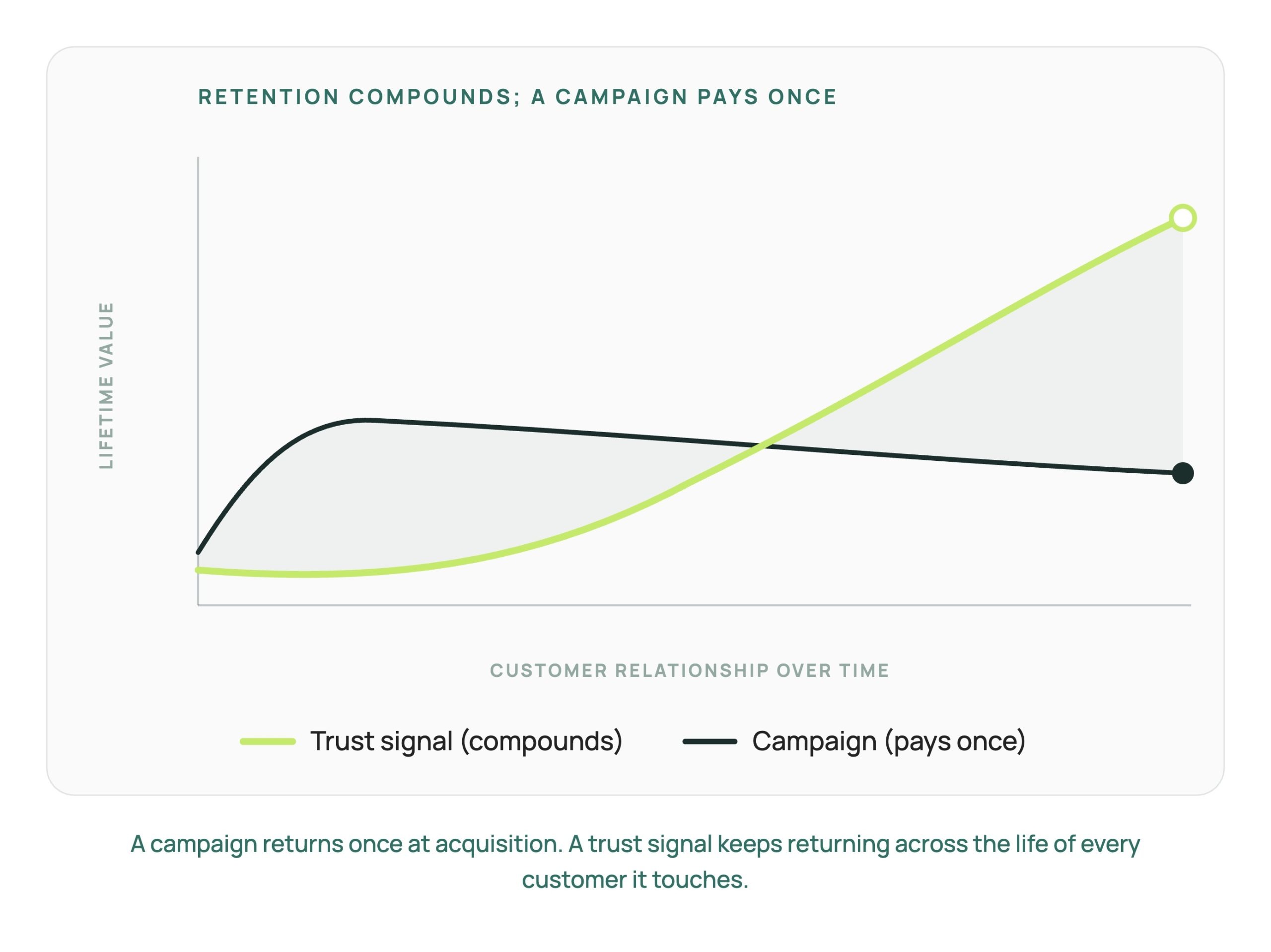
The economics favour retention. Winning a new tenant or buyer carries a full acquisition cost every time.
Keeping an existing one carries almost none, and a trusted brand converts existing customers into a referral channel that lowers blended acquisition cost across the base.
For a marketing leader measured on efficient growth, a durable trust signal outperforms an incremental campaign because its return accrues over the entire lifetime of every customer it touches.
This reframes the question from “how do we acquire more” to
“What proof of trust would make the customers we already have stay longer and speak for us”
The answer is usually a moment, not a message.
Where do property businesses miss the biggest trust moment?
Property businesses miss their biggest trust moment at the exact points of highest customer stress. A tenant signs a lease and is sent elsewhere to arrange their own cover. A buyer settles a home and has to source protection under deadline while everything else is being coordinated. The business created the moment, then stepped back from it.
These are the moments a brand is actually judged. Everything before is marketing. What the customer remembers is whether the business was present when it was stressful and consequential, or whether it handed them off to fend for themselves. A handoff at that point is a silent statement: the brand’s care ends where the customer’s exposure begins.
For a marketing leader, this is the most expensive kind of gap, because it undoes acquisition spend invisibly. The customer was won at cost, then quietly taught that the business is there for the easy parts and absent for the hard ones. That lesson shows up later as churn no campaign can recover.
How does protection function as a brand-trust signal?
Protection functions as a trust signal when the business handles it inside the journey, because it proves the brand’s care extends to the customer’s real exposure. The customer never has to break away or manage the gap. The business demonstrably looked after them at the moment that mattered most, which is exactly what builds durable loyalty.
This is a reason-to-believe, not a line item. A tenant who finds cover already handled at move-in, or a buyer who finds the protection the lender requires arranged inside the settlement flow, experiences the brand keeping its promise when the stakes are highest. That experience is worth more to lifetime value than any feature the customer has to discover and adopt themselves.
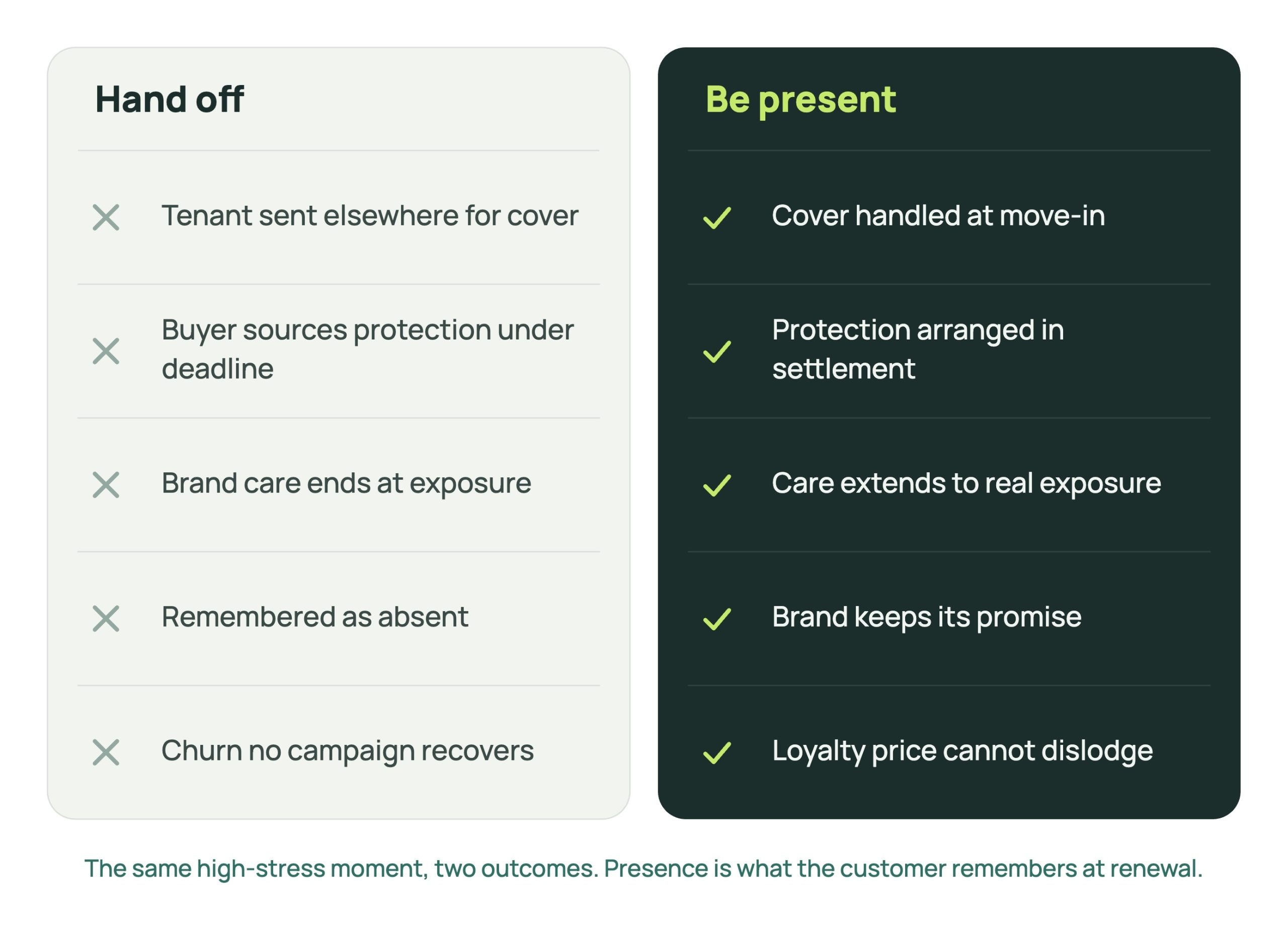
The differentiation is real and hard to copy. Any competitor can run a discount or a referral offer. A business that is genuinely present at the customer’s most exposed moment owns a trust position that price promotions cannot dislodge. It becomes a reason the customer chooses this business again and recommends it, which is the definition of a marketing asset that compounds.
Isn’t this just insurance with extra marketing language?
No.
Framing it as insurance misses what the customer experiences and what the brand earns, which is trust demonstrated at the point of highest stress. The mechanism is protection. The marketing outcome is loyalty, lower churn, and higher lifetime value.
It is worth being precise, because the instinct is to file this under “add an insurance product and promote it”, and that instinct produces the wrong result. The customer is not looking to be sold a policy inside the business. They are looking for evidence that the brand is on their side. Protection handled invisibly, at the right moment, is that evidence. The insurance is the vehicle. The brand trust it generates is the point, and the lifetime value that trust protects is what a marketing leader is actually buying.
Does shipping this mean the business becomes an insurer?
No. The platform owns the customer relationship, an insurer owns the risk, and an orchestration layer connects them. What the brand ships is a trust signal. The insurance sits underneath it, held by the insurer, not the business.
It is important to clarify that this model does not constitute broking. Because the platform facilitates the connection rather than acting as a broker itself, there is no requirement to obtain additional licences or undergo separate compliance processes.
Kanopi is a full insurance platform with AI-native tooling that lets protection be arranged inside the customer journey without the business holding a licence, staffing a compliance team, or replacing the systems it already runs. For a marketing leader, this is what makes the trust signal deliverable: it strengthens the brand at the moment of highest stress and carries none of the operational weight the word “insurance” usually implies. The customer feels the brand kept its promise. The business protects the lifetime value it paid to acquire. The risk sits where it belongs.
The most efficient growth model you is the one you haven’t shipped yet.
A property business that has invested in brand, acquisition, and customer experience has already accepted the premise this rests on: that trust, earned in the right moments, is what turns an expensive acquisition into a loyal, high-value customer.
Protection inside the journey is that trust proven at the one moment the business still leaves the customer alone.
It is not a new business model and it is not an insurance product bolted onto a campaign. It is a brand-trust signal at the point of highest stress, where loyalty is won or lost, and it lifts lifetime value across every customer it reaches.
The businesses that ship it will lower churn and deepen loyalty without spending more to acquire, which is the most efficient growth a marketing function can produce.